 Vibe Coding 101
10 vibe coding best practices for building reliable apps with AI
Ready to see what Base44 can do for you? Get started →
Vibe coding best practices are what separate an app that ships from one that gets stuck in an endless prompt-and-fix loop. If you have used an AI app builder to turn plain language into a working product, you already know how fast the good moments feel, and how frustrating it is when the AI “fixes” the same bug three times without ever solving it. Base44 vibe coding bridges the gap between a great idea and a working product, but that gap only closes cleanly when you follow a few consistent habits.
If you want a refresher on what vibe coding is first, this guide assumes you already know the basics and want to build with fewer surprises. Below are ten vibe coding best practices covering how to plan, prompt, review, and protect your codebase, so your next session ends with working software instead of a tangle of half-fixed bugs.
TL;DR: 10 vibe coding best practices
Use this table as a quick reference before and during your next vibe coding session. Most of the ten items below map directly to common vibe coding mistakes that show up again and again once an app gets past its first prototype, so if you have hit a wall before, you are in good company.
| Practice | What to do | |---|---| | 1. Apply best practices without managing the infrastructure yourself | Get planning, context management, and review built into how you build. | | 2. Plan before you prompt | Write a short spec, not a one-line request. | | 3. Keep your context clean | Reset sessions between features to avoid stale context. | | 4. Write scoped, constrained prompts | Name the goal, the limits, and what not to touch. | | 5. Review every AI-generated change | Check diffs like a pull request from a new teammate. | | 6. Test after every change | Run tests and type checks before you prompt again. | | 7. Protect sensitive code | Mark authentication, payments, and config files off-limits. | | 8. Plan schema changes first | Require a rollback path before altering your database. | | 9. Diagnose before you fix | Stop the loop: ask what is wrong before asking for a fix. | | 10. Reuse your best prompts | Turn winning prompt patterns into repeatable workflows. |
Ready to put these practices to work? Start building with Base44.
10 vibe coding best practices
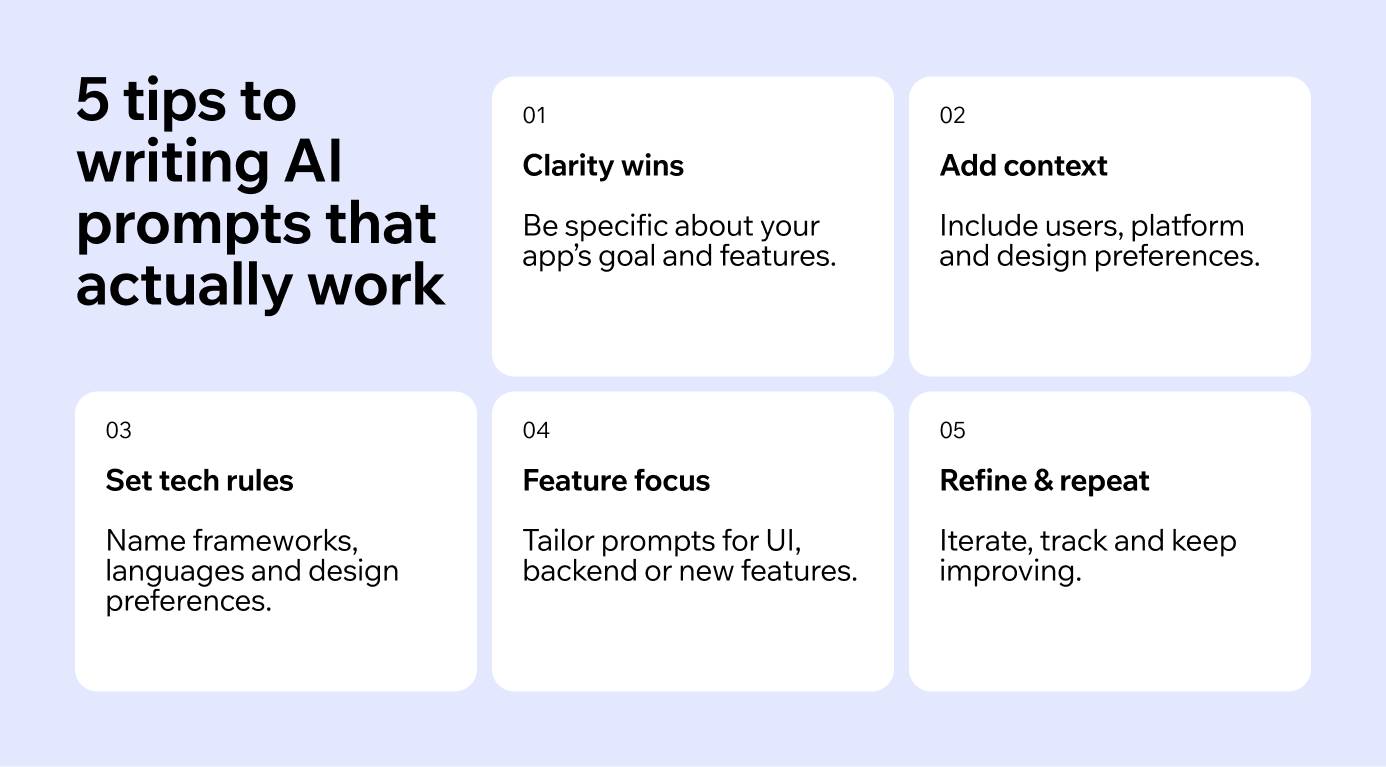
These practices apply whether you are building your first app or your fiftieth. They are ordered roughly the way a real project unfolds: start with planning, move through prompting and review, and finish with the habits that make your next project faster than this one.
- Apply best practices without managing the infrastructure yourself
- Plan before you prompt
- Keep your context clean and current
- Write scoped, constrained prompts
- Review every AI-generated change before accepting it
- Test and type-check after every accepted change
- Declare off-limits files and protect sensitive code
- Require a plan before schema or database changes
- Diagnose before you fix
- Turn repeatable prompts into reusable workflows
01. Apply best practices without managing the infrastructure yourself
Every practice on this list is something you can do manually inside any AI coding tool, but Base44 builds several of them into the product itself. Base44 gives users a real-time AI collaborator available at every step, so instead of juggling a separate planning tool, a separate reviewer, and a separate testing setup, you work inside one conversation that already understands your app's data, logic, and interface.
That matters because most vibe coding best practices exist to solve a version of the same problem: the AI loses track of what you actually want, and the output drifts from your intent. Base44 reduces that drift by managing backend infrastructure, entities, and permissions automatically, so your prompts can focus on what the app should do instead of how to wire it together.
If you are building your first app, Base44 lets you apply the practices in this list without first becoming an expert in prompt engineering or infrastructure. If you are already technical, it still saves you the setup work so you can spend your attention on the details that actually differentiate your product.
02. Plan before you prompt
The single biggest predictor of a clean vibe coding session is whether you planned before you started typing. A one-line request like “build me a booking system” forces the AI to guess at dozens of decisions: what data to store, how availability is calculated, what happens when two people book the same slot. Every guess it gets wrong becomes a bug you will find later, usually at the worst time.
Instead, treat your first message like a short specification, not a casual ask. Describe the goal, the constraints, and the edge cases you already know about. Ask the AI to propose a plan, list its assumptions, and wait for your approval before it writes any code.
This costs a few extra minutes up front. It saves far more time later, because you are correcting a paragraph of assumptions instead of debugging a paragraph of code. When your idea is still vague, that is fine. Work through the vagueness in plain language first, and only start building once you and the AI agree on what “done” looks like for this specific feature.
Think about a simple example: a dashboard that shows recent orders. A one-line prompt leaves the AI to guess whether “recent” means the last day, the last week or the last fifty orders, and whether cancelled orders should count. A planned prompt states the window, the filters, and the sort order up front, so the first version the AI builds is usually the one you actually keep.
03. Keep your context clean and current
AI coding tools perform best when they are working from a small, accurate picture of your project. As a session runs longer, the AI has more messages, more files, and more half-finished ideas to track, and the quality of its output tends to drop. This is sometimes called context rot, and it is one of the most common reasons a vibe coding session that started well ends in confusion.
Two habits keep context under control. First, give the AI a short project file with the essentials only: the stack, the conventions, and the folders it should not touch. Update it as your project changes, and remove anything that is no longer true. Second, start a fresh conversation for each new feature rather than piling everything into one long thread. When you begin a new session, restate the goal and any constraints instead of assuming the AI remembers the last one.
Neither habit takes long, and both pay off every single session for the life of the project. A lean, current project file is worth more than a long one that tries to cover every edge case you have ever encountered.
04. Write scoped, constrained prompts
Open-ended prompts produce open-ended changes. If you ask an AI coding tool to “add error handling,” it might touch every file in your project when you only meant one endpoint. That is not a bug in the tool, it is what happens when a request has no boundaries.
A well-scoped prompt names three things: the goal, the constraints, and what should not change. For example: “Add input validation to the sign-up form. Only modify the sign-up component and its validation file. Do not touch the login flow.” That level of detail takes a sentence or two longer to write, and it saves you from reviewing changes you never asked for.
It also helps to ask the AI to list the files it plans to edit before it starts, so you can catch a misunderstanding while it is still cheap to fix. Scoped prompts are one of the simplest vibe coding best practices to adopt, and they immediately shrink the size of every diff you have to review.
Constraints work in both directions. Telling the AI what to build matters, but telling it what to leave alone is just as valuable, especially in a codebase with more than one feature already working. A prompt that says “do not touch the payment flow” costs you four words and can save you an entire afternoon of unwinding an unrelated change.
05. Review every AI-generated change before accepting it
It is tempting to accept a change the moment it looks right, especially when the app appears to work. But AI coding tools sometimes make changes far outside the scope of what you asked for, including deleting files it decides are unused or renaming something it thinks is clearer.
Read every diff the way you would read a pull request from a new teammate: someone capable, but someone you have not fully calibrated to yet. Look specifically for deleted files, renamed functions, new dependencies, and any changes to authentication or payment logic. If something was touched that you did not expect, ask why before you accept it.
This does not need to slow you down much. A quick scan catches the vast majority of problems, and asking the AI to summarize what it changed and flag anything risky before you review is often enough to surface the one change that actually matters.
It helps to keep a short mental checklist for every diff: what got deleted, what got renamed, what new dependency got added, and whether anything outside the stated scope changed. Running through those four questions takes less than a minute and catches most of the changes worth questioning.
06. Test and type-check after every accepted change
Code that looks correct is not the same as code that works. AI-generated changes can pass a visual check and still fail the moment a user does something unexpected, like submitting an empty form or refreshing mid-action.
Run your tests and type checks immediately after every change you accept, not at the end of a long session. If something fails, fix it before you move on to the next prompt. Waiting even one more prompt makes it harder to tell which change actually broke things, since you are now debugging two problems layered on top of each other instead of one.
If your project does not have tests yet, ask the AI to write them as part of the same change, covering the normal case, an edge case, and an error case. This turns testing into a habit that costs almost nothing per feature instead of a separate project you keep postponing.
07. Declare off-limits files and protect sensitive code
AI coding tools are trained on enormous amounts of public code, which includes plenty of insecure patterns along with the good ones. Left unsupervised, they can introduce the same common app security mistakes a rushed human developer might make: hardcoded credentials, missing input validation or access checks that only cover the happy path.
Reduce that risk by explicitly marking sensitive areas as off-limits in your project file, including authentication, payment processing, and anything that touches environment variables. Repeat the constraint in your prompt whenever you are working near those files, since a single mention in a project file is easy for a long session to lose track of.
When a change does touch anything security-related, review it with extra care: check for exposed keys, unvalidated input, and access rules that are broader than they need to be. This is one of the vibe coding best practices that matters most once your app moves from a personal project to something real users depend on.
A useful test: imagine a stranger reading the request payload or the environment file. If anything in there would let them log in as another user, charge a card or read data they should not see, it belongs on your off-limits list, and it belongs there before you write the first prompt that touches it, not after.
08. Require a plan before schema or database changes
Database changes are harder to undo than almost anything else in your app. A renamed column or a dropped table can quietly break features you are not even looking at, and by the time you notice, you may have already lost data.
Before you let an AI coding tool touch your schema, ask for a written plan: the forward change, the rollback path, and any application code that needs to update alongside it. Review that plan the same way you would review a migration written by a colleague, and only approve the code once you understand exactly what will change and how to reverse it if something goes wrong.
This single habit prevents some of the most painful failures in vibe coding, because it forces a moment of human judgment right before the one kind of mistake that is genuinely difficult to recover from.
09. Diagnose before you fix
Every vibe coder eventually hits the same wall: a bug that will not go away no matter how many times the AI says it fixed it. This is often called the doom loop, and the instinct to keep asking for another fix usually makes it worse, since each attempt piles more changes on top of a misunderstanding no one has actually identified.
When this happens, stop asking for fixes. Start a new conversation, describe the bug, and explicitly ask the AI to diagnose the problem and report back without changing any code. If the bug is stubborn, run the same diagnostic prompt in a second fresh session and compare the two answers. Only once you are confident you understand the real cause should you let the AI write a fix.
Separating diagnosis from fixing feels slower in the moment. In practice, it is a reliable way out of a loop that could otherwise burn through an entire afternoon.
It also helps to notice the warning signs earlier. If the AI's explanation of the bug changes each time you ask, or if it proposes the same fix twice with slightly different wording, that is a sign the diagnosis was never solid in the first place, and it is time to stop and start over rather than try a third variation.
10. Turn repeatable prompts into reusable workflows
Once you have run the same kind of prompt three or four times, whether it is writing tests, reviewing security or planning a migration, it is worth saving that pattern instead of retyping it from memory every time. A short reusable prompt template for your most common tasks keeps your results consistent and saves you from rediscovering the same wording every session.
This is a long article and only part of it is shown here. Read the full article on iCARE.